MD5320 – Music Performance – Assessment 001


1 – Performance Analysis 

JPEGMAFIA – Thug Tears 

Discuss how the music is played – technique (instrument / mic etc), dynamics, tightness, feel etc  

  • One man show, played to backing track but no DJ; just him on vocals with a laptop- Vocals are way more aggressive than recorded version 

Stage presence: How are the performers commanding attention? How is the performer expressing themselves? 

  • Within the audience, no separation between him & crowd/full interaction 
  • A performance more than just regurgitating the exact same thing heard on record stood in the same spot on stage 

Comment on the presentation aesthetics – the stage set up, clothes, lighting, stage dressing etc 

  • No smoke & mirrors (no extravagant lights, stage set up, costume etc) 
  • One man band but puts on more of a show than a lot of 4 piece bands do! 

Emotional impact – how does it make you feel? Do you think it matches the artist’s intention? 

  • This version holds a lot more aggression than the recorded however it suits it perfectly & is mirrored by how he performs it 

 
What is your overall impression of the performance? 

  • In terms of instrumental & music its nothing technical at all however its a full performance. What there lacks in technicality is more than made up for in entertainment 

2 – Live Vs. Recorded – The Difference: 


Recorded version:  

Vocals are very reserved, melodic & clean which plays nicely off of the minimal instrumental & allows it to shine through, especially as he produced the track himself. This suits the environment that the listeners would listen to this in, leaving a lot of how its perceived to be interpretive. With the cleans vocals as they are it suggests R&B influence which is easier to imagine him grooving to kind tamely whilst performing. The context of what is being said & the power behind the words is brought more from the instrumental than the vocal delivery. 
 
Live Version:  

Vocals are screamed whilst he throws himself around, bringing a whole different aspect & perspective to the song. There’s an unhinged aggression to what he’s saying which also shows he is feeling every single word of the song. Performing the vocals in this way also draws it away from any R&B influence you may receive from the recorded track & therefore can only be as effective live. If he performed the vocals as clean as they are on the recorded live, the audience response would be substantially less erratic & energetic. This is clearly something he wanted to achieve and wanted to bring a whole different experience to the live show as well as break down the barrier that separates the artist from the listener, as he is seen in and amongst the crowd. Although he is slightly above the audience, there’s barely anything keeping them apart & allows his energy to transfer directly to them. 


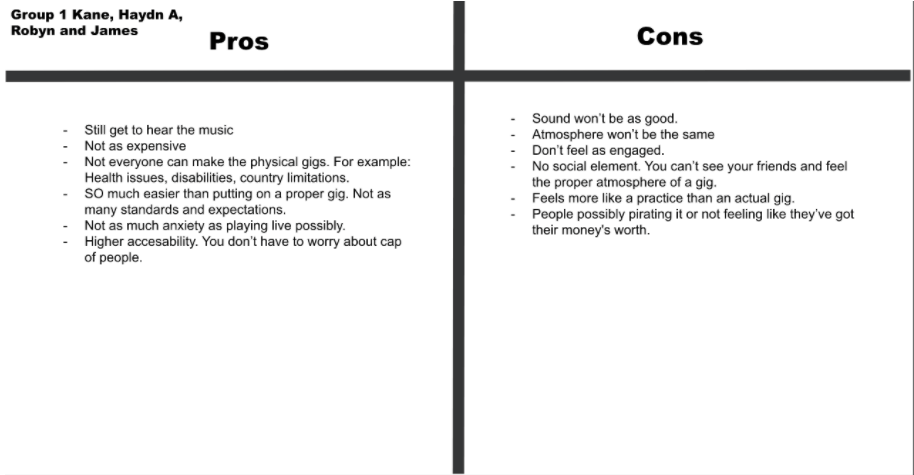
2 – Livestream Gigs Vs Actual Gigs 


3 – Tiny Desk Contest Performance

Jarvis Mousse (Haydn Alim solo project) performing a stripped down rendition of an original piece


4 – Assessment Performance 

Band Name: The Jersey Militia 

Line-up: Duncan (Rhythm Guitar, Vocals), Emrys (Lead Guitar), Haydn Brine (Bass), Haydn Alim (Drums, Vocals) 

Setlist: Wet Room, Tonic, Blinds 

Our performance consisted of 3 songs – 2 written and produced by Duncan (‘Blinds’ & ‘Tonic’) and one produced by myself (Wet Room). From the inception of the band, we realised that our musical tastes were different, spanned multiple genres and had a variety of preferred styles from person to person – both performing & general listening. We wanted to present a couple of songs displaying this and worked to make each song its own unique entity.  

Although we had influences for each song, we consciously worked outside of genre tropes or within genre boundaries to not produce a carbon copy of something else. However, as the playing styles and guitar sound remained consistent throughout, it tied each song together and didn’t make the performance feel like a compilation of cover songs. 

As for the performance itself, we realised very early on that a highly energetic stage presence would look out of place with the songs we had put together and set on focusing our presentation around what we wore & our stage positioning more so than how we move around the stage. As the bass and the drums were playing off of each other really well in each track, we wanted Haydn (Bass) near myself behind the drums to emphasise the connection between our playing. I feel as if we could have executed this a lot better and I put more focus into my playing as opposed to how we looked on stage, however I feel like my performance anxiety and self-criticism is improving drastically from prior performances. Our outfit choices (smart shirts with sunglasses) although presented us as a uniform entity with a consistent aesthetic was better in theory rather than practice. Although we practiced the set, the difficulty of performing on stage with sunglasses didn’t cross our minds in the run up to the show and we didn’t practice with them on! I think with the songs we were playing it would benefit to have them sound tight and sacrifice stage presence slightly, but I definitely feel like this was an area we could have developed a lot more and put more focus into. 

In regard to the setlist, we felt ‘Tonic’ & ‘Blinds’ could be interchangeable in the setlist as they were wildly different but would leave the performance on different notes but felt Wet Room would benefit from being the first song as it was primarily backing track as well as it being the most ambient yet progressive. This was so we could get on and off stage without sacrificing fluidity. I think this was executed extremely well and was a highlight of the performance.  

In summary, I believe how we played each song was executed well, I am very happy with the songs we produced & the other all performance ran smoothly, but I feel like we should have spent more time on our aesthetic, maybe changed our stage movement & positioning more throughout and worked on the performance aspect more. 
MD5313 – SESSION NINE – Rehearsal Development

I was unable to attend this session due to personal health problems and was in hospital, but once out and on painkillers I was in contact with the other members of the band to talk about what I’d missed, what the progress on the song and performance was and what they needed from me. I took the week to recover but wrote down any rough ideas I had in the meantime.

MD5313 – SESSION TEN – Rehearsal Development

This session was identical to the previous weeks session and was a continuation of the writing & song development.

From the previous week, we picked up where we left off and worked on connecting the B & C Sections with a transition to make it flow a little more naturally. Duncan put forward a lead line that me & Emrys could support with simple whole note chords. This also worked well in the transition of me going from Lead to Rhythm and makes the change less jarring. We tightened & cleaned everything up with a few run throughs, tying any loose ends, and were only left with the ending to suss out.

Like last week, the half hour of the session was dedicated to performances. I focused a little more on my stage presence this time in preparation for the assessment performance, and I also took a little more time to get a good tone out to perform with. The new additions to the song seemed to be received well and we received some positive feedback, one of which was to work on volumes between us but overall the general idea was to keep doing what we were doing.

We had been keeping Theo up to date with each week and our progress with each performance, & did so with this sessions. He was ready and eager to get to work on editing both the performance footage and the original composition.

Following our Monday session, we booked one last practice later on in the week to finish the writing stages and clean everything up. We added one last section which consisted of Section A the chord progression in reverse, double time over the two bars as opposed to four. This felt more resolved than leaving it on the C Section or trying to reintroduce the A or B section but also made it more relevant to the first half of the song & didn’t feel out of place. Throughout the week I had been writing and gathering lyrics for my section and put the finishing touches on them in this last writing session. Although they were only loosely based on the themes of the song, I feel like I could have done a lot better with them had I spent more time on them and had a broader theme to work with.

MD5313 – SESSION EIGHT

After a very brief introduction, we were left to develop our original compositions either in the TC-104 Computer Rooms then in a Practice Room or vice versa. We spent the first half on the computer. Emrys played around with some ideas for rhythms on logic whilst both me & Duncan worked on our blog posts.

Once the first half of this session was finished we moved to the Practice room and began further writing on our song. From our last session, was had an A section, B section & a very rough idea for a C section. After jamming through some ideas, I suggested a slight change in tone to sustained chords and Duncan taking over on Lead Guitar whilst I focus on more chord based playing. The section I introduced had a more sombre, melancholic feel to it which contrasted nicely with the very bright, up beat indie groove of the B section. I also suggested I take on lead vocals for a bit of variety and dynamics.

At the end of this session we played what we had so far to the rest of our peers and gained feedback & constructive criticism. What we received was very positive and was told the sound we were working with was very unique. My nerves were still present and I still struggle with my stage presence but I am seeing slight improvements from last time even after months out of practice.

MD5313 – SESSION SEVEN – Presentations

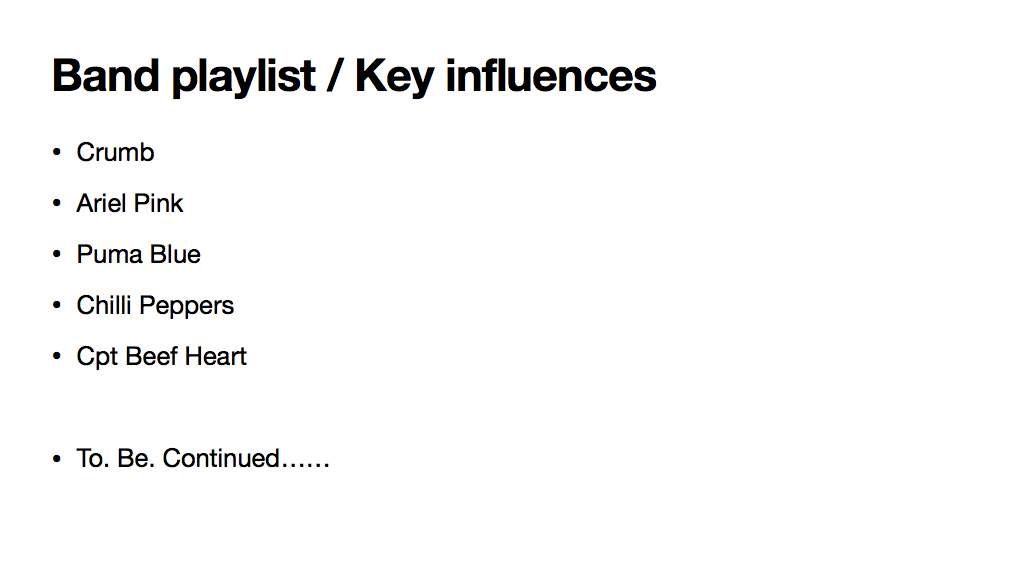
We presented our Band Presentation on Microsoft teams alongside the other bands in class. It was not only good to almost read back to ourselves who & what we are but interesting to see what everyone else was aiming for & doing. We also put together a Spotify playlist of our influences for this project to refer back to during our writing and development

This helped as I also felt more confident in what we were doing and ready to start writing our pieces. The following weekend we booked a practice room to spitball some ideas and create a backbone for our Original Composition. Following the the rainfall idea discussed in my last blog post, I began by using mostly single plucked notes going down in scale to represent the fall of rain, but as Duncan was doing something similar with his guitar sections, I decided to open my sections up more to represent the size & space of being outside as well as using reverb with a long tail as a texture to sonically represent the aesthetic of rainfall at night.

MD5313 – YFP WEEK

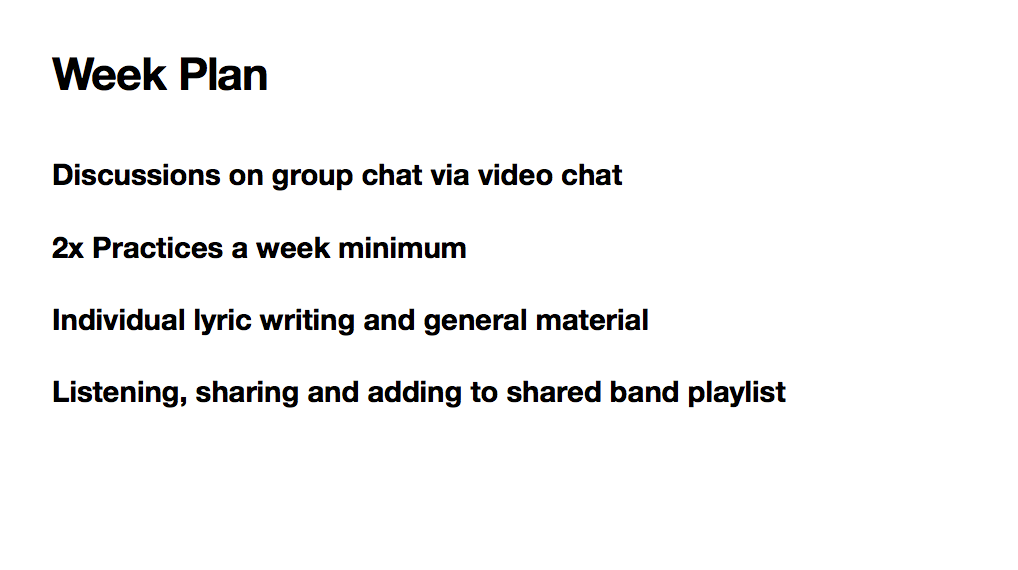
During this week I caught up with work for a few other modules & discussed the assessment for this one with my group (Duncan, Emrys & Theo). We spoke online via video chats & Facebook Messenger about a band name, our roles in the band, our sonic influences & a weekly plan. We prepared a short presentation to display all of this information ready for the following session.

We had some ideas involving prosody but decided to wait till we were all in the same room to run through ideas and begin writing properly as it would be more efficient & easier than doing so online.

MD5313 – SESSION SIX – What Is Local?

Due to Wales moving into lockdown, this session took place on Microsoft teams. Although I find it harder to focus & engage with the online sessions it was great to discuss this topic and hear a large variety of perspectives & opinions.

We discussed what the relevance of local music was in the largely connected modern world is; if it is or isn’t relevant at all. After reading through an article covering this, we shared our thoughts on an online padlet. There was many interesting things to take away from this, such as the potential existence of ‘virtual local scenes’ and entire genres being created online. Where it could be argued that local music is no longer bound to a specific area of the world but a specific group of people, works & ideas. On the other hand though, a large aspect of local music is the performance, legacy, folklore & either economical, social, political or general response to the real world location of these musicians & artists. Those who adapt that sound are merely using it for its sonic aesthetic & are culturally appropriating that which is not authentic to them. For example that of the Seattle Grunge scene of the 90s, or Late 70s Post Punk being a response to life in Post Industrial Britain. I personally think local music can only exist outside of virtual spaces in the real world, however in todays climate with the pandemic forcing music to be performed & reside primarily online it either suggests the idea of local music is evolving into a more broad ideology or is dying out. I have very mixed opinions about this as I love supporting my local music scene, however it is very limited & I do find most of my music worldwide. For myself as a musician though, its a lot easier to connect with people worldwide than it is to do so solely within the confinements of my local area as my tastes in music don’t always necessarily align with what is popular amongst other bands, artists & fans here.

The second half of this session consisted of talking about and working with an online collaborative DAW called BandLab. I have used the phone app to record some demos, song ideas & riffs but wasn’t aware of its browser based interface. We were tasked with working in groups from home on this software to try and conjure up a song, as well as give feedback on this method of collaboration.

Myself, Duncan & Emrys teamed up to try to do so but struggled coming up with anything substantial. As it was a DAW none of us had used before it took us a little while to get to grips with it and navigate around it. Once that was sussed out we then had the trouble of it lagging & the response being slow. I also think that having all hands on deck in one project made things difficult & complicated on top of communication being more difficult virtually. I personally think this is an ineffective way of collaborating, although it might have been more efficient if we each took turns to edit or add stuff then save it for the next person to do the same, it doesn’t hold up against being in the same room sharing ideas. For working by yourself it is perfect but as a collaborative effort I would not take to this again or at least dedicate more time to realising a more efficient to doing so.

MD5313 – SESSION FOUR – Style & Substance

The subject of Camp was what we mostly discussed in our week four session. It’s a term, suggested by Susan Sontag in her book ‘Notes on Camp’, that is used to describe something outrageously exaggerated in image & style. Over-the-top, extravagant, passionate, daring. It’s often fusing elements of popular culture & fashion; something that is authentic & specific to the person.

I interpreted this as unconventional imagery & almost method acting, akin to David Bowie’s many characters or how James Osterberg used Iggy Pop to express some animalistic opinions and feelings. I liked this as it was essentially being the best, most unique version of yourself vamped up to the max. These are ideas I have been toying with whilst working & writing on music that I wish to perform as I feel like it would help me engage more with the work to take on a full character change and would help me with my performance anxieties. I don’t think it’s the clothes you have necessarily, although they do play a massive part of the ideology as a whole, but more so how you are within the world around you and within the context of your work/art. This also tied into us discussing authenticity as well.

We then began analysing ourselves as musicians and figure out what defines us/what could be exaggerated or projected aesthetically. Here is my mind map:

I feel like image plays a massive part in performance and after this lecture, although not necessarily camp, I am heavily interested in analysing my image as a performer and putting thought into it, maybe even develop characters.

MD5313 – SESSION THREE – Writing Better Lyrics

Although the bulk of this session was self explanatory. We began it working & fine tuning on our Prosody pieces in groups. We were briefly reviewed and worked on them to fit the meaning behind the lyrics sonically. The feedback we received for our first draft of the Prosody song mainly focused on the theme we were basing our song around & how it would be hard to sonically represent it consistently for the duration of a two minute song. Now with Theo joining our group on Synth, we spent the session shifting the theme & deciding what would work better.

Prior to this session Theo had a traumatic experience driving home from Uni where he had collided with a deer that jumped in front of his car & severely shook him up. With this heavy on his mind he suggested it and the ideas began to generate faster & more frequently. We focused on the momentum of the song, following a sombre, tired drive home then a drastic sonic change in the BPM, chord progression & atmosphere of the song to represent the hit and how it emotionally effected him.

I feel like this draft of our song was the more effective & efficient way to portray prosody as the subject was a lot easier to represent and work with. I am happy with the song & even though I was unsure that the subject would be suitable for what we were trying to achieve, I believe it turned out to be successful overall.

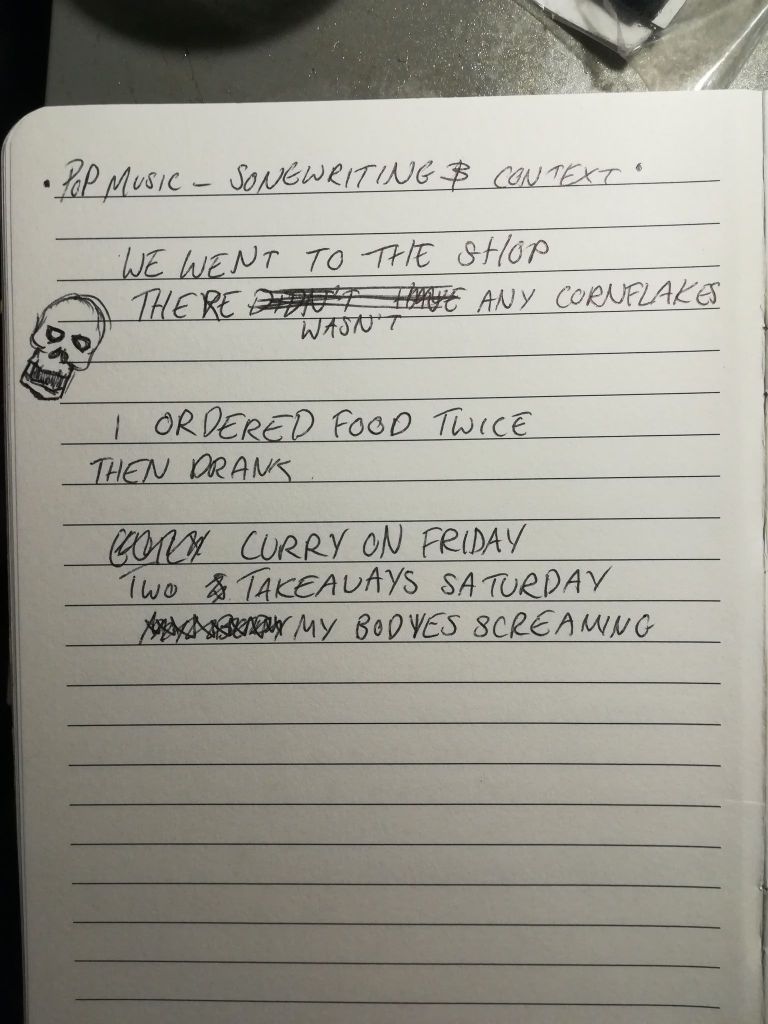
The second half of the session was split into two sections – the first being a group discussion on songwriting methods, how we write currently and methods to help us do so in the future. The second section consisted of exercises & experiments involving lyric writing, the first involved writing as freely as possible for 2 minutes, then swapping with the person sat next to you & reading through theirs, picking out your favourite phrases.

We repeated this again, however we used the phrases we liked the most from the other persons lyrics to create a set of lyrics of our own. This was great as it took all the pressure off of rhythmic structure, melody & tempo to focus purely on the words & context which made it extremely liberating & easy to conjure up themes and imagery.

The second exercise consisted of writing haikus; a Japanese Poem that focuses on a set syllabic structure. The first line 5 syllables, the second 7 & the third 5 again (5 – 7 – 5). This also allowed me to look at writing lyrics a completely different way and think about the words & message more than other sonic elements of what is being said.